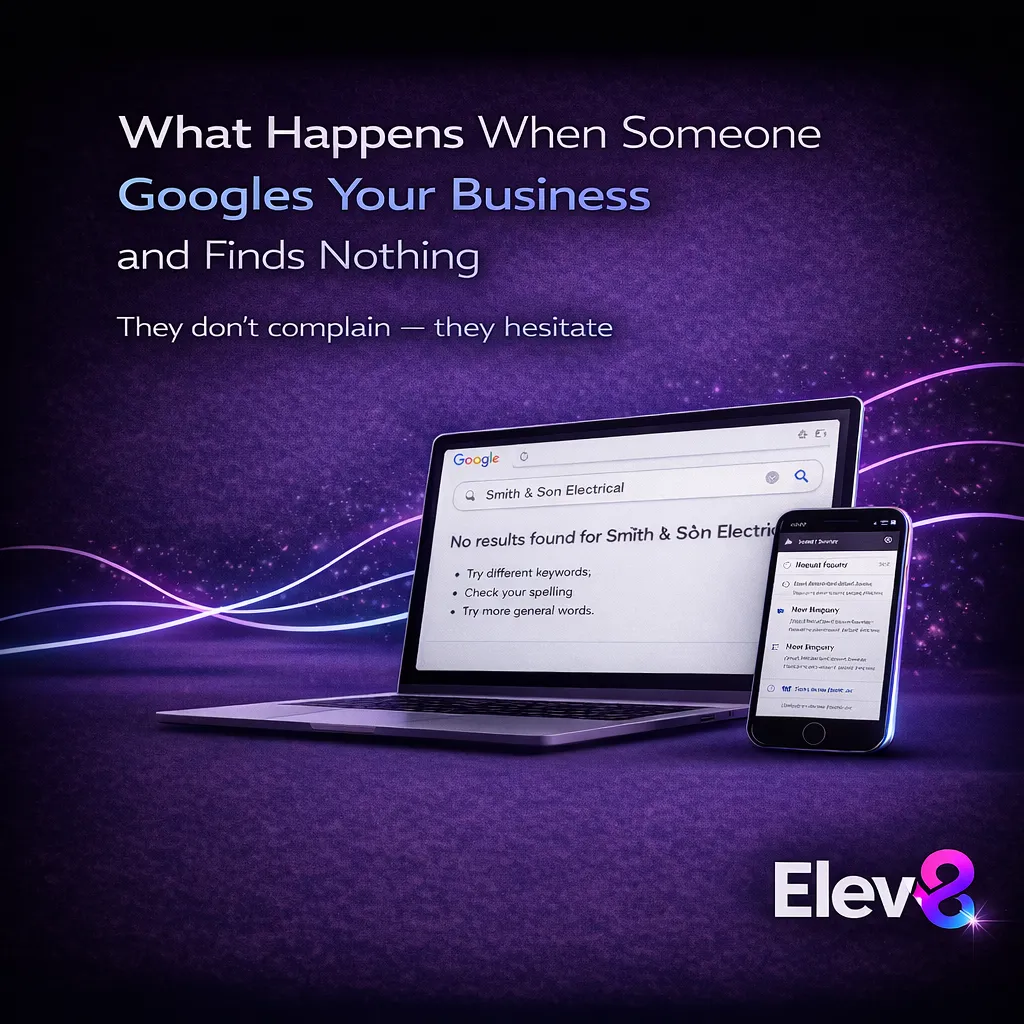
What Happens When Someone Googles Your Business and Finds Nothing
For many small business owners, being invisible on Google does not feel like an active problem. Work still comes in through referrals, WhatsApp messages, or repeat customers. Because of this, it is easy to assume that not showing up online is neutral.
In reality, when someone searches for a business and finds nothing meaningful, something does happen. It may not be obvious, and it rarely shows up as direct feedback, but it influences trust, confidence, and whether a customer decides to take the next step.
This article explains what typically happens when someone Googles your business and finds no website, no clear information, or no professional presence, and why this matters even if your business is already operating successfully.
Why People Google a Business in the First Place
Customers usually Google a business for one simple reason: confirmation.
This often happens after:
Receiving a referral
Seeing a business name on social media
Finding a business on Google Maps
Hearing about a service through word-of-mouth
At this stage, the customer is not comparing prices or judging expertise. They are checking whether the business feels real, established, and safe to contact.
Google is the default tool for this check.
The First Impression Happens Quietly
When someone searches and finds nothing useful, they rarely announce it.
There is no message saying:
“I didn’t find you, so I changed my mind.”
Instead, hesitation happens silently.
The customer may:
Delay contacting you
Look for another option
Decide to “come back later”
Choose a competitor that looks clearer online
This is why the impact of being invisible is often underestimated.
What “Finding Nothing” Usually Looks Like
Finding nothing does not always mean zero results.
It often looks like:
No website in search results
Only a Facebook page with limited information
Inconsistent business details
No clear explanation of services
No obvious next step
From a customer’s perspective, this feels incomplete.
How Customers Interpret the Absence of Information
When customers cannot find clear information, they subconsciously fill in the gaps.
Common assumptions include:
The business may be very new
The business may not be fully established
Information may be outdated
Support or accountability may be unclear
These assumptions are not accusations. They are risk assessments.
A website exists largely to reduce this uncertainty.
Why Competitors Benefit From Simply Existing Online
Competitors do not need to be better to look better.
A competitor with:
A basic website
Clear service explanations
Visible contact details
often appears more established than a business with no online presence, even if the actual service quality is similar or worse.
This is why businesses without websites often feel overshadowed online:
https://elev8webdesigners.co.za/blog/category/for-local-businesses
The Role of Google in Trust Formation
Google does not create trust on its own, but it influences it.
When Google can show:
A website
Consistent business information
Supporting pages
it reinforces the idea that the business is legitimate and active.
When Google shows very little, uncertainty increases.
This is part of why Google visibility is about foundations first, not rankings:
https://elev8webdesigners.co.za/google-visibility-services
Referrals Are Still Affected by This
Even referred customers Google businesses.
Referrals do not bypass the need for confirmation. They simply shorten the decision process.
If someone is referred to your business and finds nothing online, the referral loses strength. The customer may still enquire, but the confidence level is lower.
This is one reason why referral-only businesses experience inconsistent enquiry flow:
https://elev8webdesigners.co.za/blog/category/Website-Basics
Why Silence Is Not Neutral
Many business owners assume that if customers do not complain, nothing is wrong.
In reality:
Customers rarely explain why they chose someone else
Missed opportunities are invisible
Hesitation leaves no trace
The absence of feedback does not mean the absence of impact.
What a Website Changes in This Moment
A website does not need to impress. It needs to clarify.
At the moment someone Googles your business, a website should:
Confirm what you do
Show that you are real and active
Make contact easy
Reduce doubt
This is the core role of a first website, not aggressive lead generation:
https://elev8webdesigners.co.za
This Does Not Mean You Are Losing Every Search
Not every customer will walk away.
Some will still call.
Some will still message.
Some will rely entirely on the referral.
But enough hesitation happens quietly that over time it affects:
Enquiry consistency
Confidence
Growth predictabilit
Why This Matters More as a Business Grows
As a business becomes more established:
Costs become more predictable
Time becomes more valuable
Quiet periods become more stressful
At this stage, invisibility on Google becomes more noticeable, not less.
Having a simple online presence helps stabilise perception, even before it drives growth.
Conclusion
When someone Googles your business and finds nothing, they do not assume the business is bad. They simply hesitate.
That hesitation often leads to delays, second-guessing, or choosing a business that feels clearer online. This happens quietly and consistently, which is why it is easy to miss.
A basic website and visible presence do not replace referrals or relationships. They support them by reducing doubt at the exact moment customers seek reassurance.
