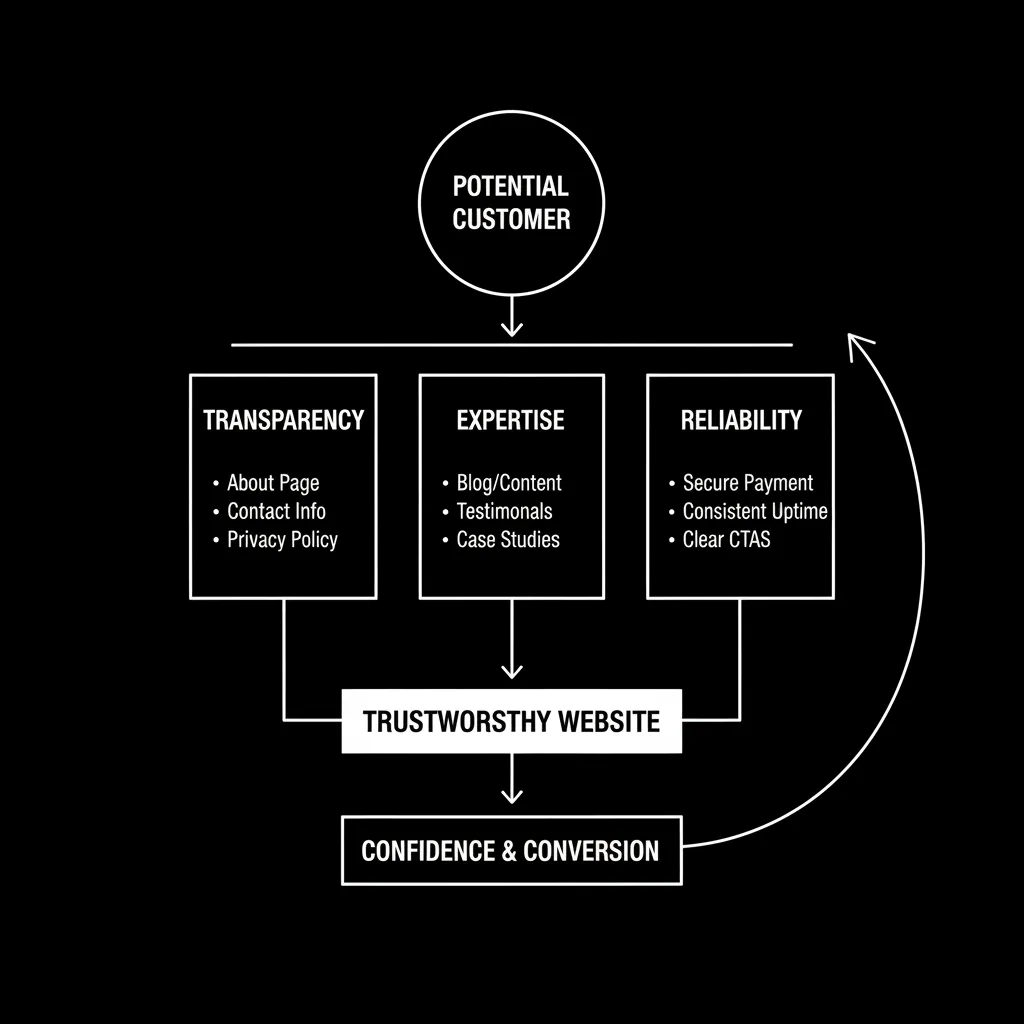
What makes a website trustworthy to potential customers

For many small and local businesses in South Africa, a website is the first point of contact between the business and a potential customer. Before a phone call is made or a message is sent, visitors assess whether the business appears legitimate, reliable, and professional.
Trust is not created through design alone or by adding more features. It is built through clarity, consistency, and signals that help visitors understand who you are, what you do, and whether you are credible. This article explains what makes a website trustworthy from a customer’s perspective, how Google indirectly evaluates trust, and what practical steps businesses can take to improve it.
Why Website Trust Matters
When visitors land on a website, they usually make an initial judgement within seconds. This judgement is not emotional or dramatic. It is based on simple questions:
- Is this a real business?
- Do they clearly explain what they offer?
- Can I contact them easily?
- Do they look established and legitimate?
If these questions are not answered quickly, visitors leave. This behaviour also affects Google visibility, because Google observes how users interact with websites over time.
-
Trust From a Customer’s Perspective vs Google’s Perspective
It is important to separate two related but different concepts.
- Customer trust is based on clarity, professionalism, and reassurance.
- Google trust is based on consistency, relevance, and signals gathered across the web.
A trustworthy website for customers usually aligns well with what Google looks for, but the starting point should always be the human visitor.
Clear Business Identity
One of the most common trust issues is uncertainty about who the business actually is.
A trustworthy website clearly displays:
- Business name
- What the business does
- Where the business operates
- How to get in touch
This information should be easy to find without scrolling excessively or clicking through multiple pages.
Websites that hide or downplay basic business information often appear unreliable, even if the service is legitimate. This is a foundational principle covered in structured website basics, not advanced marketing tactics.
Professional and Consistent Design
Design does not need to be complex to build trust, but it does need to be consistent.
Trust is reduced when visitors see:
- Inconsistent fonts or colours
- Poor spacing and alignment
- Low-quality images
- Broken layouts on mobile devices
A clean, readable layout signals that care has been taken. It suggests the business values presentation and attention to detail. This does not require expensive visuals, but it does require structure and restraint.
Consistency across pages matters more than visual creativity.
Clear Service Explanations
Visitors trust websites that explain services clearly and practically.
Each service should answer:
- What is offered
- Who it is for
- What problem it solves
- What to expect next
Vague language such as “tailored solutions” or “end-to-end services” often reduces trust because it avoids specifics. Customers want clarity, not marketing phrases.
Well-structured service pages are a core part of a reliable website and directly support long-term Google visibility. This approach aligns with how Elev8 structures content within its Google visibility and SEO framework.
Real Contact Details and Accessibility
Trust increases significantly when visitors can easily confirm that a real business exists.
This includes:
- A working phone number
- A professional email address
- A physical address or service area
- A contact page that actually functions
Using a custom domain email instead of free email services also contributes to credibility. Contact information should be consistent across the website and match external listings.
Social Proof and Evidence
Customers often look for confirmation that others have interacted with the business.
This can include:
- Testimonials
- Client logos (where appropriate)
- Case examples
- Google reviews
Social proof should be genuine and relevant. Overloading a page with exaggerated claims or anonymous testimonials can have the opposite effect.
For local businesses, a verified Google Business Profile with real reviews is one of the strongest trust signals available.
Content Quality and Accuracy
Trustworthy websites are well-written and accurate.
Issues that reduce trust include:
- Spelling and grammar errors
- Outdated information
- Contradictory statements across pages
Content does not need to be long, but it should be clear, current, and relevant. Regular updates signal that the business is active and engaged.
This is also one of the indirect ways Google evaluates website reliability over time.
Transparency and Expectations
Trust is strengthened when websites set realistic expectations.
This includes:
- Clear pricing ranges or explanations (where appropriate)
- Honest timelines
- Clear boundaries of what is and is not included
Websites that avoid all specifics may appear cautious, but they often feel evasive to customers. Transparency reduces uncertainty, which directly supports trust.
Technical Trust Signals
Some trust factors are not visible to visitors but still matter.
These include:
- Secure HTTPS connections
- Fast and stable hosting
- Mobile-friendly design
- Proper page structure
While customers may not consciously notice these elements, poor performance or security warnings quickly damage credibility.
Technical stability is a foundational layer that supports everything else on the website.
Consistency Across the Web
Trust is reinforced when business information matches across platforms.
Google and customers compare:
- Website details
- Google Business Profile
- Social media pages
- Online directories
Inconsistencies create doubt. Even small differences in phone numbers or business names can reduce confidence and visibility.
This is why website trust is closely linked to broader local SEO efforts, not just what appears on the website itself.
Conclusion
A trustworthy website does not rely on persuasion or design trends. It earns confidence by being clear, consistent, and professional. For small businesses, trust is built through practical decisions: clear explanations, real contact details, accurate information, and steady maintenance.
When a website helps visitors understand the business without confusion, it supports both customer trust and long-term Google visibility. This approach sets realistic expectations and creates a stable foundation for growth.
