Why Having No Website Makes Customers Hesitate
Many small business owners rely on social media pages, messaging apps, or word-of-mouth to attract customers. While these channels can bring enquiries, the absence of a website often creates hesitation for potential customers, even if the business itself is legitimate and capable.
This hesitation is rarely emotional or dramatic. It is usually practical. Customers want clarity, reassurance, and confirmation before they make contact. A website plays a specific role in providing that reassurance, especially for first-time interactions.
This article explains why not having a website causes uncertainty, how customers actually think when they search, and why a website still matters even when other platforms are working.
How Customers Decide Whether to Trust a Business
When someone hears about a business or sees it on social media, they rarely make a decision immediately. Instead, they do a quick check.
This usually involves:
Searching the business name on Google
Looking for basic information
Checking consistency across platforms
At this point, customers are not analysing design or marketing language. They are simply asking: Is this business real, active, and reliable?
A website provides a central place where this information lives. Without it, customers must rely on fragmented information from social profiles, posts, or reviews, which increases uncertainty.
The Difference Between Discovery and Confirmation
Social media is often good at discovery. People come across businesses through posts, shares, or recommendations.
A website plays a different role: confirmation.
When customers want to confirm details, they usually look for:
A clear description of services
Location or service area
Contact information
Signs that the business is established
If no website exists, customers may still enquire, but many pause or move on. This hesitation is not a rejection; it is a lack of confidence.
This is especially important for local businesses, where trust and clarity matter more than brand personality. Elev8 often sees this pattern when businesses rely only on social platforms:
https://elev8webdesigners.co.za/blog/category/for-local-businesses
Why Social Pages Alone Often Fall Short
Social platforms are not designed to explain a business clearly.
Common limitations include:
Information scattered across posts
Important details buried or missing
Layouts that prioritise engagement, not clarity
Frequent platform changes
Customers must piece information together themselves. Some will do this. Many will not.
A website allows a business to control how information is presented and ensures that essential details are easy to find.
What Customers Look for When They Can’t Find a Website
When customers search and do not find a website, they often assume one of the following:
The business is very new
The business is not fully established
Information may be outdated
Support or accountability may be limited
These assumptions are not always fair, but they are common. A website helps counter them by showing consistency and intent.
The Role of Google in Customer Hesitation
Google is often the final step in a customer’s decision-making process.
When a business does not have a website:
Google has less information to show
Search results look incomplete
The business appears less defined
Even when a Google Business Profile exists, a website adds depth and context. It supports Google’s understanding of what the business offers and who it serves.
This connection between websites and visibility is part of broader Google visibility fundamentals:
https://elev8webdesigners.co.za/google-visibility-services
Why This Matters More for First-Time Customers
Repeat customers already trust the business. First-time customers do not.
A website is often the first place a new customer goes to:
Understand services
Check professionalism
Confirm legitimacy
Without this reference point, hesitation increases. Some customers will still enquire, but many will choose a business that feels clearer and easier to evaluate.
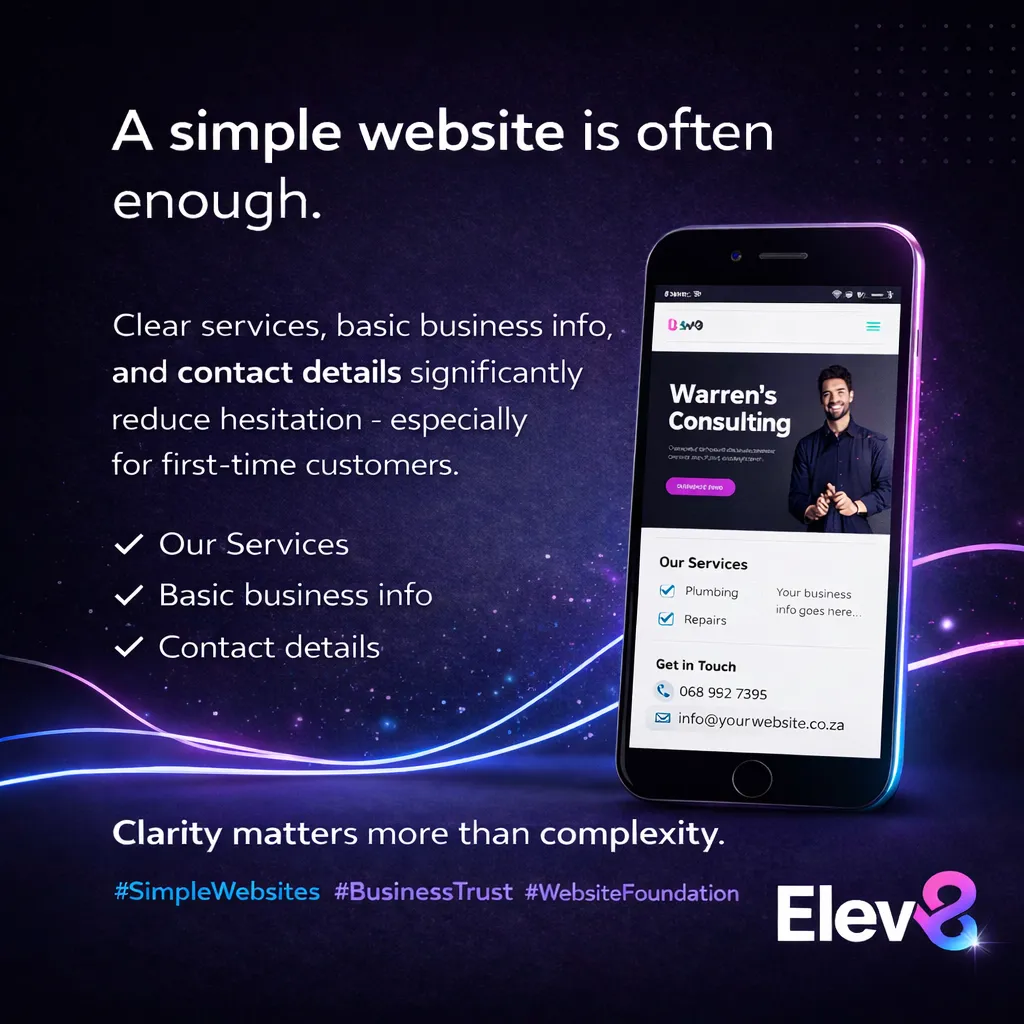
A Website Does Not Need to Be Complex
One common misconception is that a website needs to be large or expensive to be effective.
For many small businesses, a simple website that includes:
A clear explanation of services
Basic business information
Contact details
Consistent branding
is enough to reduce hesitation significantly.
This is why Elev8 Web Designers focuses on practical, structured websites rather than over-designed solutions.
How a Website Supports Trust Over Time
Trust is not built instantly. Over time, a website:
Signals stability
Shows consistency
Supports referrals
Reinforces word-of-mouth
When someone is referred to a business, they often still look it up. A website helps that referral feel safer and more complete.
Conclusion
Having no website does not mean a business cannot succeed. However, it does introduce hesitation for many potential customers, especially those encountering the business for the first time.
A website provides clarity, confirmation, and reassurance. It supports how customers search, compare, and decide. For small businesses, especially in competitive local markets, this clarity often makes the difference between an enquiry and a missed opportunity.
