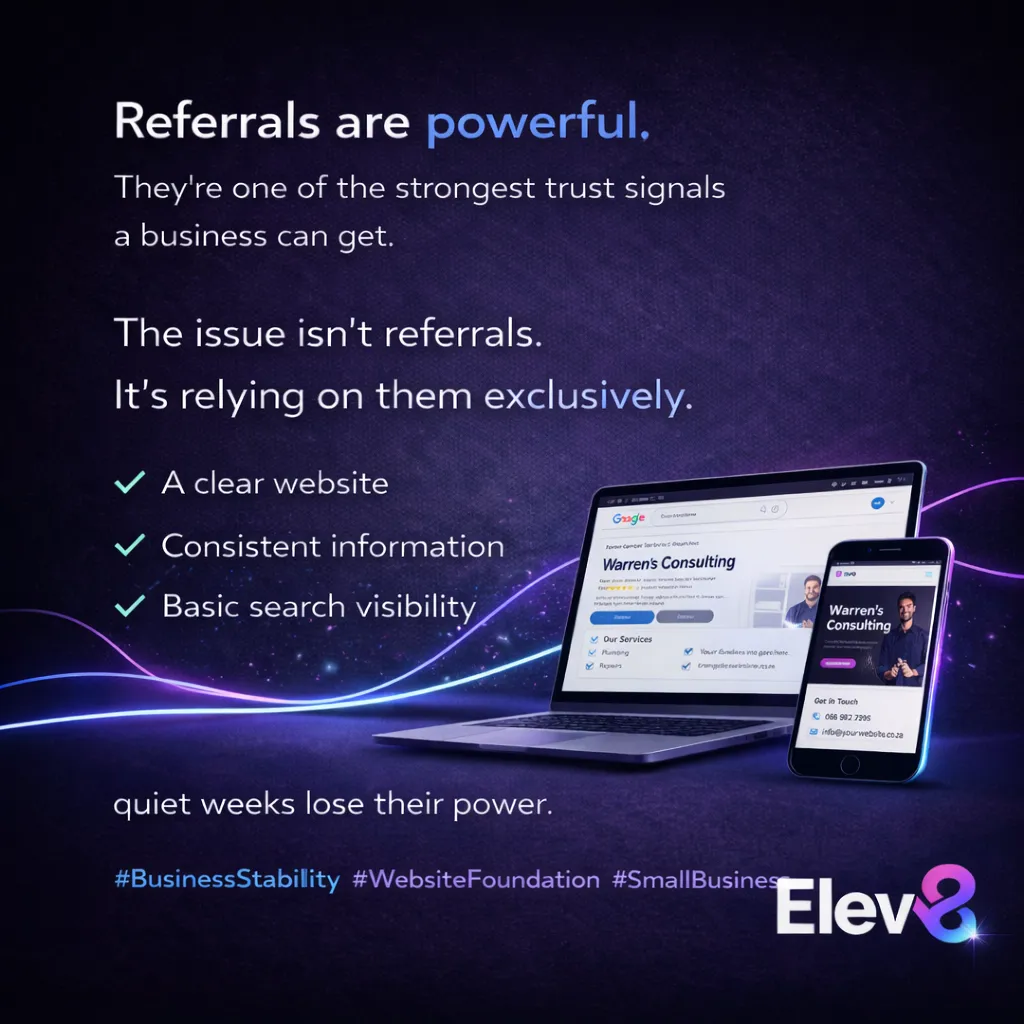
Why Relying Only on Referrals Leads to Quiet Weeks
Referrals are one of the most trusted ways small businesses get work. When a customer recommends a business, it carries credibility that advertising often cannot match. Because of this, many small businesses rely almost entirely on referrals to generate enquiries.
While referrals are valuable, relying on them alone often leads to uneven demand. One month can feel busy and stable, while the next feels unexpectedly quiet. This pattern is common and usually not a reflection of the quality of the business or its service.
This article explains why referral-only growth creates quiet weeks, how customer behaviour affects referral flow, and why visibility plays an important supporting role.
How Referrals Actually Work
Referrals are reactive, not controllable.
They happen when:
A customer has a positive experience
Someone asks that customer for a recommendation
The timing aligns with a need
None of these factors are predictable or consistent. Even happy customers may not refer often, and when they do, it depends on external circumstances.
This makes referrals an unreliable sole source of enquiries.
Referral Timing Is Out of Your Control
Customers do not refer businesses on a schedule.
A customer may:
Refer two people in one month
Refer no one for six months
Refer someone long after working with the business
Quiet weeks often occur simply because no one happens to be talking about your services at that moment.
This is not a failure. It is a natural limitation of referral-based growth.
Referrals Still Trigger Online Checks
Even when someone is referred, they usually still look the business up online.
At this point, customers want to:
Confirm the business exists
Understand what it offers
Check basic credibility
If there is little or no online presence, hesitation increases and referrals convert less reliably.
This is where a basic website supports referral flow rather than replacing it.
Why Quiet Weeks Feel Worse Over Time
As businesses grow, fixed costs increase.
Quiet weeks become more noticeable when:
Expenses are predictable
Income becomes inconsistent
Planning becomes difficult
Relying only on referrals makes forecasting almost impossible. This creates unnecessary stress even for otherwise healthy businesses.
Referrals Do Not Create Ongoing Visibility
Referrals happen in private conversations.
They do not:
Improve Google visibility
Build public awareness
Accumulate discoverable trust signals
Once the conversation ends, the opportunity disappears. There is no lasting footprint.
Online presence, on the other hand, compounds over time.
Why Online Visibility Stabilises Enquiry Flow
A visible online presence introduces a second stream of discovery.
This includes:
Google searches
Local results
Brand lookups after referrals
Even modest visibility helps smooth out quiet weeks by ensuring the business can still be found when referrals slow down.
This is part of how Google visibility supports stability rather than quick growth.
This Does Not Mean Referrals Are Bad
Referrals are still one of the strongest signals of trust.
The issue is not referrals themselves, but exclusivity.
When referrals are supported by:
A clear website
Consistent business information
Search visibility
they convert more reliably and reduce the impact of quiet periods.
What Businesses Mistake for “No Demand”
Quiet weeks often get misinterpreted as:
The market being slow
Customers losing interest
Competition outperforming
In many cases, demand still exists. The business simply has no visible way to be found when referrals pause.
A More Sustainable Approach
A more stable approach combines:
Referrals
A basic website
Search visibility
Clear business information
This does not require aggressive marketing or constant content creation. It requires presence and consistency.
This foundation-focused approach is how Elev8 supports long-term stability for small businesses.
Conclusion
Relying only on referrals creates uneven demand because referrals are unpredictable by nature. Quiet weeks are not a sign of poor service, but a sign of limited visibility.
By supporting referrals with a basic online presence, businesses can reduce uncertainty, stabilise enquiry flow, and plan with more confidence.
